
Beneath the Surface: Why India's Coral Reefs Are Flashing a Warning Sign

Ashish Kumar Jha
Research Intern, MRC | IIT Kanpur
Key Highlights
- Lakshadweep's coral cover has fallen by roughly half in 24 years — from 37.24% in 1998 to 19.6% in 2022 — and 2024 brought its most severe bleaching event on record.
- India's four major reef systems span about 2,384 sq km and directly support the food, income, and coastal safety of millions of fisherfolk, from the Gulf of Kachchh to the Andamans.
- The world has just lived through its worst global bleaching event on record — heat stress capable of triggering bleaching struck roughly 84% of the planet's reefs between 2023 and 2025, confirmed by NOAA to have finally eased in 2026.
- A new predictive model — tracking ocean heat, cloud cover, and currents together — can give Indian reef managers years of advance warning instead of only finding out after the damage is done.
- Without early warning and planning, India's reefs risk following the path of Australia's Great Barrier Reef, where bleaching now returns faster than corals can recover.
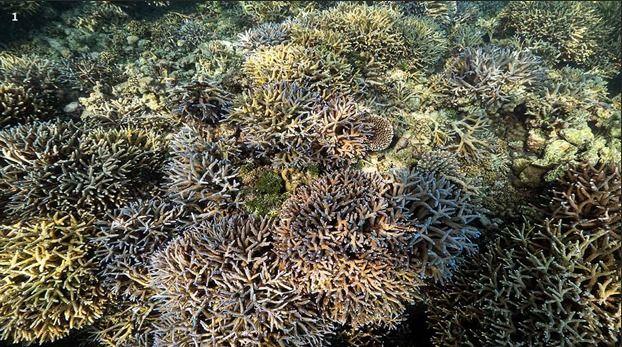
India's coastline, as re-measured by the Survey of India using modern high-resolution charting, now stands at 11,098.81 kilometres — 7,870.51 km along the mainland and 3,228.30 km across its island territories. Hidden just beneath the waves along this vast stretch lies a living wall that few people ever think about — until it starts to disappear. From the shallow, silty reefs of the Gulf of Kachchh, to the biodiversity-rich waters of the Gulf of Mannar, to the atolls of Lakshadweep and the sprawling reef systems of the Andaman and Nicobar Islands, India is home to one of the most varied coral reef landscapes on Earth. These reefs cover less than 1% of the ocean floor worldwide, yet support more than a quarter of all marine species, and globally deliver close to $375 billion a year in services — food, coastal protection, and tourism — to people who often have no idea they are relying on a coral reef at all.
But these reefs are dying, and faster than most people realise. Coral bleaching — the process by which corals expel the algae that give them colour and food, turning ghostly white under heat stress — has gone from a once-in-a-generation event to something closer to routine. When bleaching happens too often, corals never get the calm years they need to recover and reproduce. This is not a distant problem confined to Australia's Great Barrier Reef. It is happening in Indian waters, right now.
Full Article Content
Sign in to read the complete article.

Ashish Kumar Jha
Research Intern, MRC | IIT Kanpur
Ashish Kumar Jha is an undergraduate student in the Department of Mechanical Engineering at IIT Kanpur, currently working as a research intern at the Maritime Research Centre (MRC). His work focuses on coral bleaching prediction and climate modelling across India's reef systems, feeding into a broader Marine Spatial Planning Toolkit.