
Shared Waters, Shared Futures? The Brahmaputra in India–China Relations

Atul Mangal
Research intern at MRC
Key Highlights
- “If World War III ever happens, it will be fought over water.”
- In June 2000, it was observed that the Siang River, which is the Brahmaputra’s name in Arunachal Pradesh, rose by 30 meters and flooded almost the entire town.
- The concept of Underwater Domain Awareness can play a pivotal role in ensuring long-term sustainability and regional security in the Brahmaputra basin.
- The future of the Brahmaputra must be guided by cooperation, not competition; by shared responsibility, not unilateral ambition.
By Atul Mangal, IIT Delhi
“On July 19, 2025, Chinese Premier Li Qiang officially launched construction of the world’s largest hydropower dam at the Great Bend of the Yarlung Tsangpo — just before it enters Arunachal Pradesh as the Brahmaputra. Costing over $167 billion, the megaproject is expected to produce 300 billion kilowatt-hours of electricity annually. While China celebrates it as a project of the century, India views it as a potential threat to water security.”
In recent years, water has increasingly become a strategic asset, and nowhere is this more visible than in the transboundary flows of the Brahmaputra. “If World War III ever happens, it will be fought over water”: a warning that feels uncomfortably close to reality in this region.
Introduction
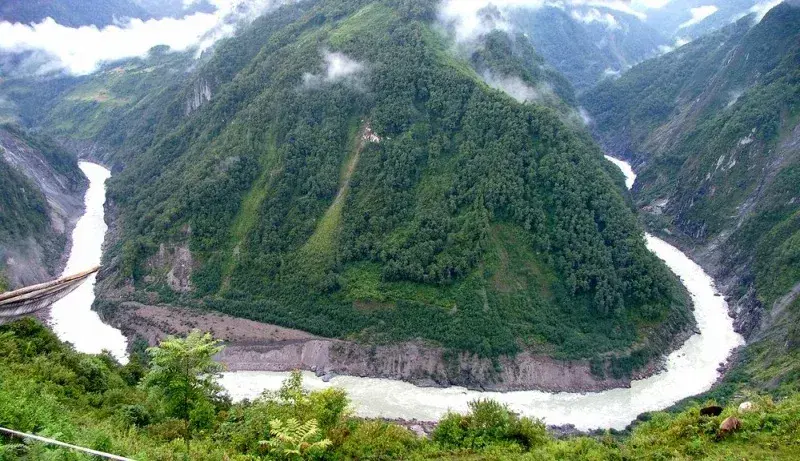
The Brahmaputra River originates from the Kailash range of the Himalayas at an elevation of 5,300 m. It flows through China (known as Yarlung Tsangpo), India, and Bangladesh (known as Jamuna), and its basin also includes Bhutan. It is the ninth-largest river in the world by discharge and the 15th longest. Its average depth is 30 m, and the maximum depth is 135 m at Sadiya town of Assam. It supports about 130 million people across the four nations.
Full Article Content
Sign in to read the complete article.

Atul Mangal
Research intern at MRC
Atul Mangal is pursuing his B.Tech. in Chemical Engineering from IIT Delhi. As a Summer Intern at MRC, he contributed to a research project on ‘Modelling and Simulation for the Brahmaputra River,’ where he worked on scientific analysis and computational modelling to support riverine domain research.